
1.Introduction
The Ministry of Cohesion and Regional Development, the institution responsible for the implementation of Cohesion Policy and European Territorial Cooperation in Slovenia, organised the first national consultation on post-2027 Cohesion Policy. The aim of the consultation was to build first common baselines to help the government develop official position for the negotiation on the multiannual financial framework that is already underway.
Minister Jevšek highlighted the need to have an open expert discussion and kick off national dialogue, stressing that the future financial perspective would be full of challenges and changes. Some member states (mostly net contributors) call for a reformed Cohesion Policy, while most of them wish to keep things as they are, both in terms of the scope and the main implementation principles. However, simplifications are necessary, including a funding system that is beneficiary friendly.
Future Cohesion Policy will focus on the green and digital transition, with the university-enterprise collaboration playing a key role in this respect. Special emphasis will also be put on energy self-sufficiency, demographic trends and strong regions. The government wishes for the regions to directly manage the allocated funds, while the ministry would be responsible for monitoring the regularity and legality of project implementation. EU enlargement will become another important topic on the agenda, and Slovenian businesses should strive to seize this opportunity. It is important that we channel cohesion funding into development of knowledge, entrepreneurship and infrastructure, all of which brings added value.
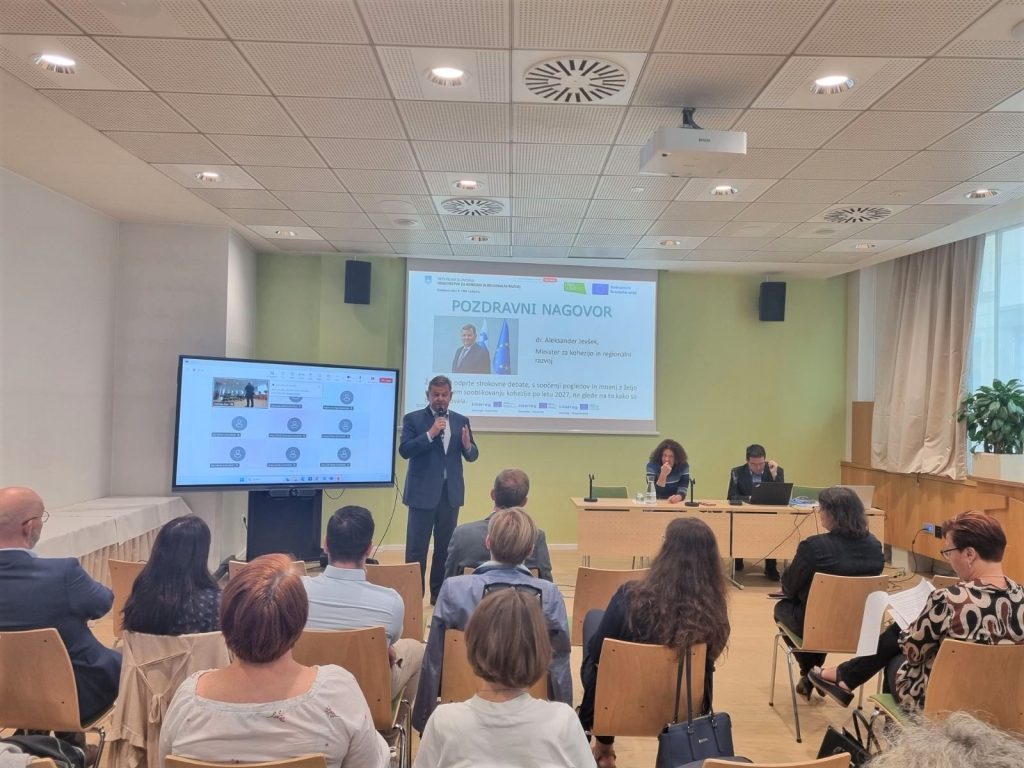
Discussion on important aspects of future Cohesion Policy followed the remarks delivered by the minister. The starting points for the discussion were outlined by the representatives of the Ministry of Cohesion and Regional Development.
2. Lessons learned from the previous programming periods as outlined by the participants (based on the questionnaires filled out and received prior to the event)
2.1 Baselines
Where are we now? What is the way forward?
We need Cohesion Policy. We need European Territorial Cooperation. The green and digital transition, climate change, demographic change and development gaps remain key challenges to be tackled in the future.
Preserving key principles, tailoring action to meet the actual needs of regions, introducing simplifications for the managing authority and other stakeholders, building administrative capacity, embracing the place-based approach, ensuring synergies with other policies, developing the post-2027 Cohesion Policy proposal by July 2025.
Emerging challenges such as security, migrations, the twin transition, education, housing, and EU enlargement are coming to the forefront; Cohesion Policy will also have to tackle issues such as low absorption, complementarity of funding systems, place-based approaches.
2.2 Key takeaways:
3. Financial aspects of project financing in the future
3.1 Baselines
Budget cuts will be manifested through increased competitiveness, higher borrowing costs, and promotion of innovation and efficiency.
Which steps are needed to successfully combine funding sources: ensuring effective planning and coordination, designing a comprehensive financial strategy, strengthening institutional capacity, ensuring effective monitoring and evaluation and promoting cooperation.
3.2 Key takeaways:
4. Impact of changes in implementing rules on project implementation
4.1 Baselines
4.2 Key takeaways
5. Conclusions and next steps
Hi, my name is EMA, how can I help you?